
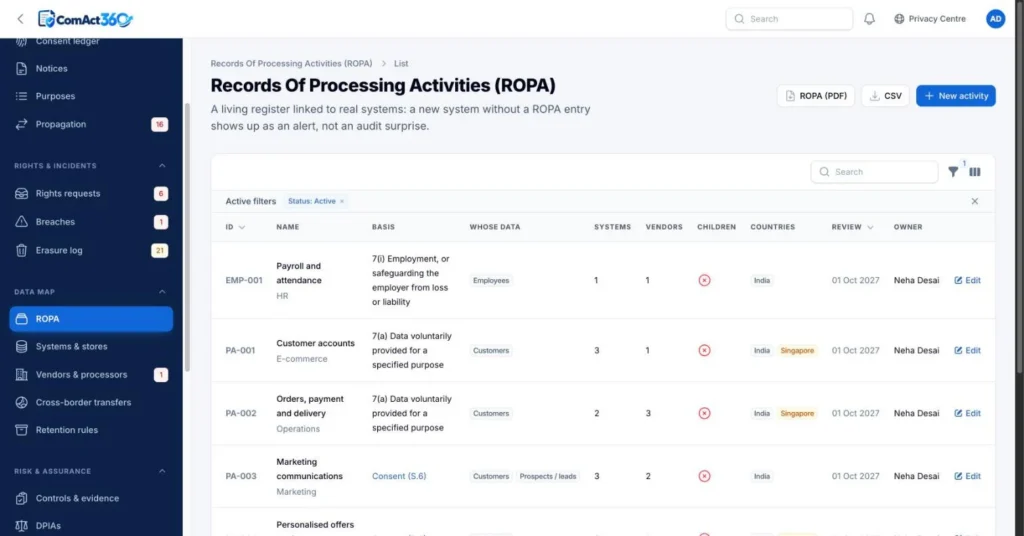
Short answer: A data map, often kept as a record of processing activities (ROPA), lists every purpose for which you process personal data, the legal basis, whose data and which data, the systems and vendors involved, where it is stored, how long you keep it and who owns it. The DPDP Act does not use the term ROPA, but you cannot write an itemised notice, answer rights requests, report a breach or erase data on time without one.
Most compliance projects stall because nobody knows where personal data actually lives. Start with the map, and every other DPDP duty becomes a query instead of a scramble.
Why the DPDP Act needs a data map
- Notices (Section 5, Rule 3) must itemise the personal data and purposes.
- Access requests (Section 11) need a summary of the data and the processors it was shared with.
- Erasure (Section 8(7), Section 12, Rule 8) must reach every system and processor.
- Breach notices (Rule 7) need to know whose data was in the affected system.
- Security safeguards (Rule 6) must cover every place data is stored.
- Significant Data Fiduciaries must carry out a yearly Data Protection Impact Assessment and audit (Rule 13), which starts from the map.
The columns your ROPA needs
| Column | Example |
|---|---|
| Activity and owner | Marketing communications, owned by the marketing head |
| Purpose | Send offers by SMS and WhatsApp |
| Legal basis | Consent (Section 6) or a legitimate use (Section 7) |
| Whose data | Customers, prospects, employees, patients, students |
| Data items | Name, mobile number, purchase history |
| Children’s data? | Yes or no; if yes, verifiable parental consent (Section 9) |
| Systems | CRM, SMS campaign tool, website |
| Vendors / processors | SMS provider, hosting company |
| Countries | India, Singapore (cloud backup) |
| Retention | Until consent is withdrawn, then erase |
| Safeguards | Role-based access, encryption, logs kept one year |
| Review date | Every 12 months or when anything changes |
Retention: decide it per purpose
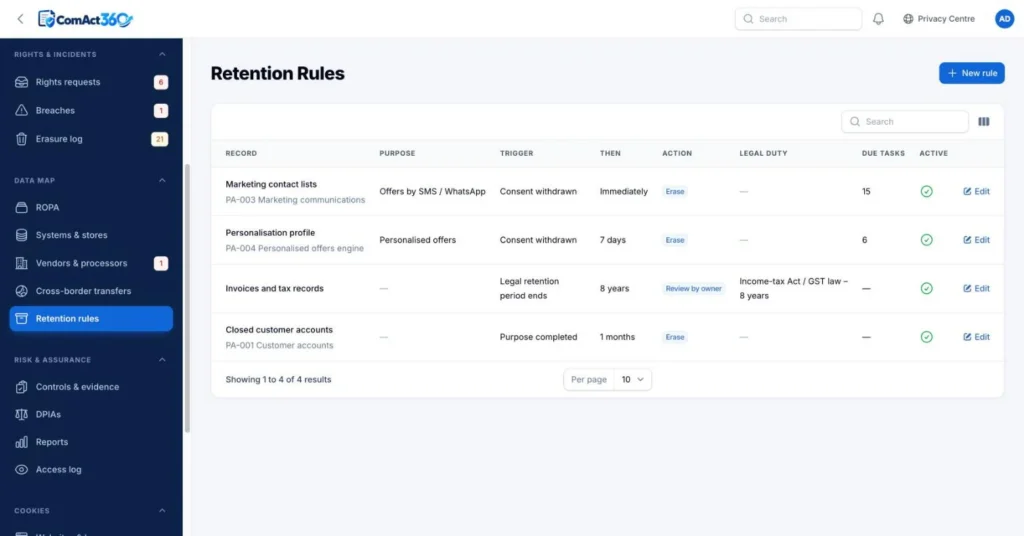
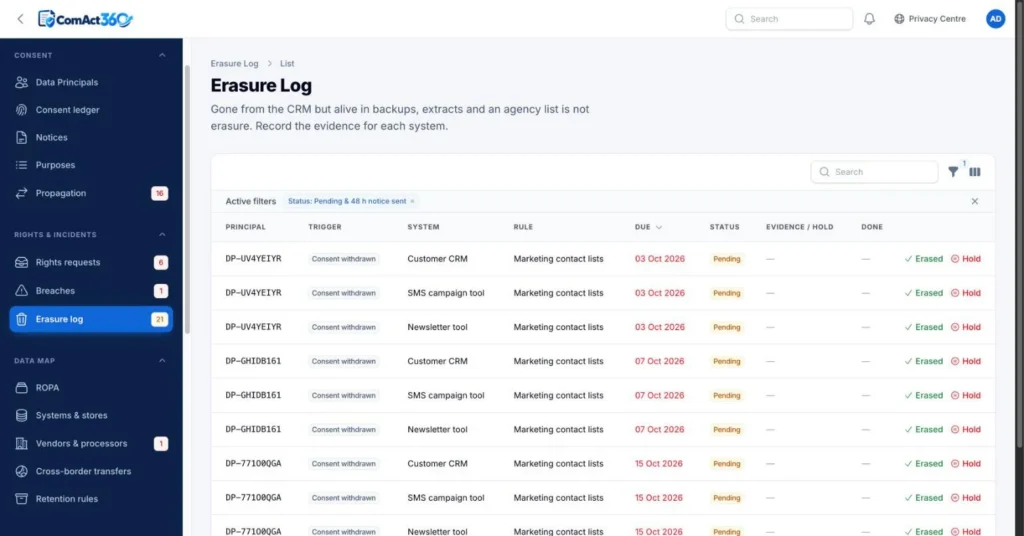
The Act says personal data should be erased once the purpose is served and consent is withdrawn, unless a law requires you to keep it. Rule 8 adds specifics: large e-commerce entities, online gaming intermediaries and social media intermediaries above set user thresholds must erase data after three years of the person’s inactivity; you must give the person at least 48 hours’ notice before erasing on that ground; and you must keep the personal data, traffic data and logs needed for specified purposes for at least one year. Record a retention rule for each purpose and run the erasures from it.
Cross-border transfers
Section 16 lets you transfer personal data outside India except to countries the Government restricts by notification, and sector rules (for example in banking or insurance) still apply. Record the country for every system and vendor so you can react if a country is notified.
How to build the map in two weeks
- List your systems: website, apps, CRM, ERP, billing, HR and payroll, e-mail and WhatsApp tools, shared drives, spreadsheets.
- List your vendors who touch personal data.
- Interview each team for 30 minutes: what data, why, where, for how long, shared with whom.
- Fill the columns above, one row per purpose.
- Flag gaps: no legal basis, no contract, no retention rule, data in an unknown spreadsheet.
- Name an owner and a review date for every row.
How ComAct360 helps
ComAct360 by Re-Infotech keeps your ROPA linked to real systems and vendors, so a new system without a ROPA entry shows up as an alert. Retention rules create erasure tasks automatically, with 48-hour notices where needed and an erasure log as evidence, and the ROPA exports to PDF or CSV for auditors. The screenshots are from ComAct360 with sample data.
Book a free ComAct360 demo or read the DPDP Act compliance guide.
This guide explains the law in plain language for business owners and teams. It is not legal advice; check specific situations with your legal adviser or Data Protection Officer.
Sources and further reading
Official sources we referred to. Laws and platform rules change, so check the latest version.
- Digital Personal Data Protection Act, 2023 (India Code, Government of India)
- Digital Personal Data Protection Rules, 2025 (Ministry of Electronics and IT)
Frequently asked questions
Is a ROPA mandatory under the DPDP Act?
The Act does not use the term ROPA, but its duties on notices, rights requests, erasure, breach reporting and security safeguards all depend on knowing what personal data you hold, why, where and for how long. A ROPA is the practical way to show that.
How long can a business keep personal data under DPDP?
Only as long as needed for the purpose, unless a law requires longer. Rule 8 sets a three-year inactivity limit for large e-commerce, online gaming and social media intermediaries, a 48-hour notice before such erasure, and a minimum one-year retention of logs and related data.
Can personal data be stored outside India?
Yes, except in countries the Government restricts by notification under Section 16, and subject to stricter sector rules such as those in banking or insurance.
How often should a data map be reviewed?
At least once a year, and whenever you add a system, vendor or purpose. Significant Data Fiduciaries must also carry out a yearly DPIA and audit.
More DPDP guides
- DPDP Act compliance guide (start here)
- DPDP consent management: valid consent and how to prove it
- Data breach notification: CERT-In in 6 hours, the Board in 72 hours
- Handling DPDP rights requests
- Data processor contracts under DPDP
- Cookie consent banners under the DPDP Act