
Short answer: India’s DPDP Act gives people (Data Principals) the right to a summary of their personal data, to correct, complete, update or erase it, to grievance redressal and to nominate someone to act for them (Sections 11 to 14). You must publish how to make a request, respond to grievances within the period you publish, which cannot exceed 90 days (Rule 14), and search every system that holds their data before you answer.
Rights requests look simple until the first one arrives: a customer asks you to delete everything, and the data sits in your website, CRM, billing system, WhatsApp tool, e-mail platform and an agency’s spreadsheet. This guide explains each right and a process that holds up when the Data Protection Board asks how you handled it. These duties apply from 13 May 2027.
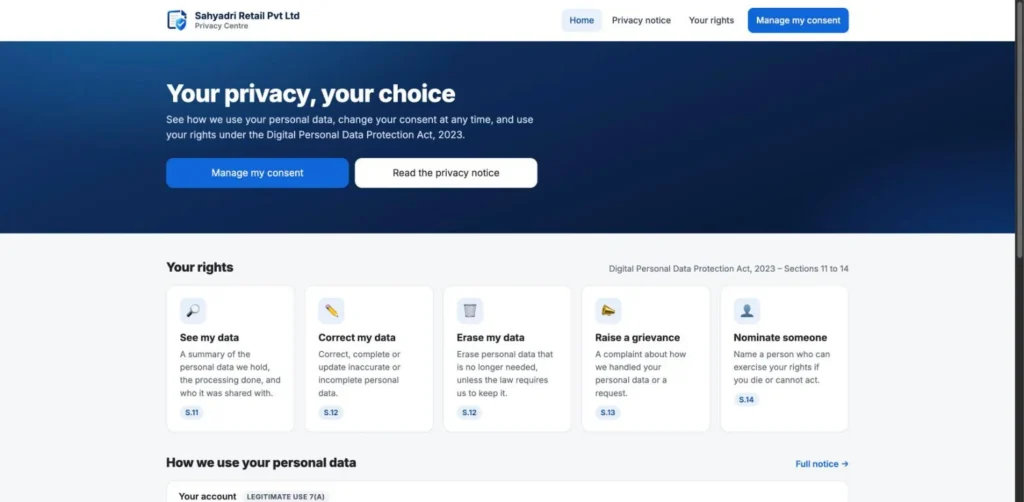
The five rights
- Access (Section 11): a summary of the personal data you process about them and the processing activities, the identities of other Data Fiduciaries and Data Processors you shared it with, and a description of what was shared.
- Correction and erasure (Section 12): correct inaccurate or misleading data, complete or update it, and erase data that is no longer needed for the purpose, unless keeping it is necessary for that purpose or required by law.
- Grievance redressal (Section 13): a readily available way to complain about how you handled their data or a request. People must use your grievance process before going to the Board.
- Nomination (Section 14): name one or more people to exercise their rights if they die or cannot act.
- Withdrawal of consent (Section 6(4)): often arrives as a “request” too, and must be handled as quickly as the consent was given.
Deadlines
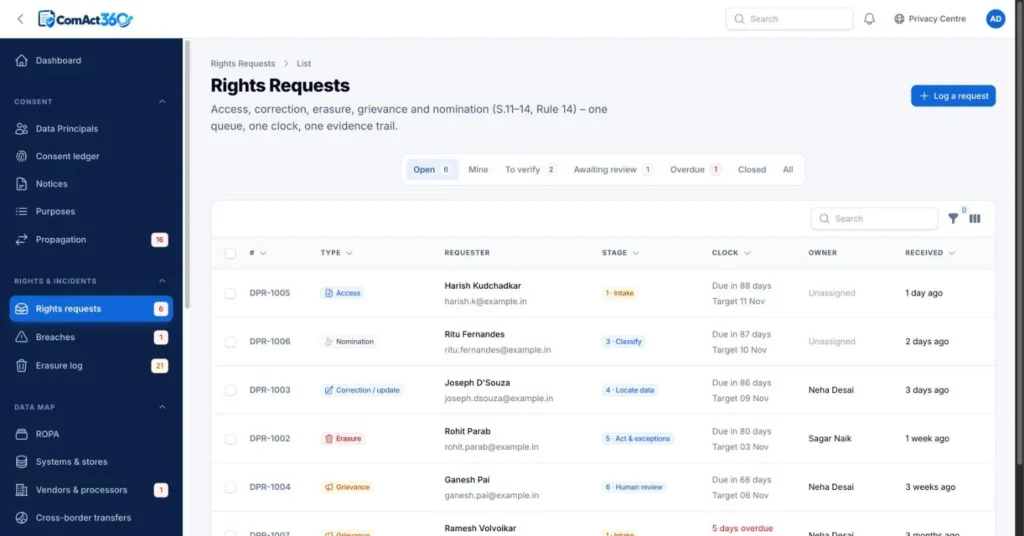
Rule 14 requires every Data Fiduciary to publish, on its website or app, how people can make requests and the period within which grievances will be answered. That period cannot be more than 90 days. Set a shorter internal target, for example 15 to 30 days, so you have room for identity checks and searches, and track both dates.
An 8-step process for every request
- Intake: log the request from any channel (website, e-mail, phone, store) in one queue with a reference number.
- Verify identity: confirm the requester is the person, or their nominee or guardian, without collecting more data than needed, for example an OTP to the registered e-mail or mobile.
- Classify: access, correction, erasure, grievance or nomination, and the deadline.
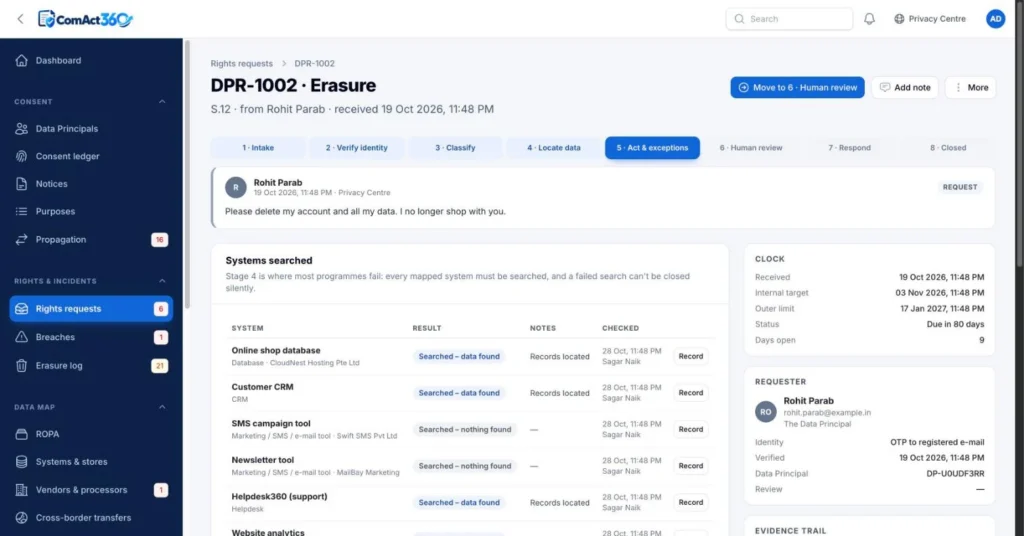
- Locate data: search every system and processor on your data map, and record the result for each, including “nothing found”.
- Act and check exceptions: correct or erase, unless a law such as tax or GST rules requires you to keep certain records.
- Review: the DPO or a senior person checks the answer.
- Respond: reply in plain language, explaining what was done and any data you kept and why.
- Close: keep the evidence of every step.
Common mistakes
- Deleting from the CRM but not from backups, exports, the newsletter tool or a vendor’s system.
- Asking for an ID copy when an OTP would do, which creates more personal data to protect.
- Answering from memory instead of searching each system.
- No record of the request, so you cannot show the Board what you did.
- No owner, so the request sits in a shared inbox until the deadline passes.
How ComAct360 helps
ComAct360 by Re-Infotech gives you one queue for access, correction, erasure, grievance and nomination requests, with a clock on each. Requests move through the 8 stages above, every mapped system must be searched and recorded before a request can close, and a customer-facing Privacy Centre lets people make requests without e-mailing you. The screenshots are from ComAct360 with sample data.
Book a free ComAct360 demo or read the DPDP Act compliance guide.
This guide explains the law in plain language for business owners and teams. It is not legal advice; check specific situations with your legal adviser or Data Protection Officer.
Sources and further reading
Official sources we referred to. Laws and platform rules change, so check the latest version.
- Digital Personal Data Protection Act, 2023 (India Code, Government of India)
- Digital Personal Data Protection Rules, 2025 (Ministry of Electronics and IT)
Frequently asked questions
What rights do people have under the DPDP Act?
The right to a summary of their personal data and how it was processed and shared, to correction, completion, updating and erasure, to grievance redressal, and to nominate someone to act for them (Sections 11 to 14), plus the right to withdraw consent.
How long does a business have to respond to a DPDP grievance?
The business must publish its response period, and under Rule 14 it cannot be more than 90 days.
Can a business refuse to erase data?
Yes, where keeping the data is necessary for the specified purpose or required by law, for example invoices that tax or GST rules require you to keep. Explain this in your reply.
Do people have to complain to the business first?
Yes. Under Section 13, a person must use the business’s grievance redressal process before approaching the Data Protection Board.
More DPDP guides
- DPDP Act compliance guide (start here)
- DPDP consent management: valid consent and how to prove it
- Data breach notification: CERT-In in 6 hours, the Board in 72 hours
- Data mapping and ROPA for DPDP
- Data processor contracts under DPDP
- Cookie consent banners under the DPDP Act