
Short answer: Under India’s Digital Personal Data Protection (DPDP) Act, 2023, consent must be free, specific, informed, unconditional and unambiguous, given by a clear affirmative action, and limited to the data needed for the purpose. It must follow a clear notice, be as easy to withdraw as to give, and you must be able to prove it: which notice the person saw, which purposes they agreed to, when and how.
Consent is the legal basis for most marketing, personalisation and data sharing that Indian businesses do. The DPDP Rules, 2025 were notified on 13 November 2025, and the notice, consent and record-keeping duties apply from 13 May 2027. This guide explains what “valid consent” means in practice and how to set up your forms, website and systems so you can show it.
What the DPDP Act says about consent
Section 6 of the Act sets the test. Consent must be:
- Free: not forced as a condition for something unrelated.
- Specific: given for a stated purpose, not “any purpose we choose later”.
- Informed: given after the person has seen a notice that explains the data and purposes.
- Unconditional and unambiguous: no hidden conditions, no guessing.
- By a clear affirmative action: ticking an unticked box, tapping “I agree” or similar. Silence, pre-ticked boxes or simply continuing to browse do not count.
- Limited to necessary data: consent only covers the personal data needed for that purpose.
If any part of a consent breaks the Act, that part is invalid. And if your business relies on consent, Section 6(10) puts the burden on you to prove that a notice was given and consent was given.
Notice comes first
Every request for consent must come with, or be preceded by, a notice (Section 5 and Rule 3). The notice must be understandable on its own and give:
- An itemised description of the personal data you will collect.
- The specific purposes, and the goods or services each purpose enables.
- How the person can withdraw consent, use their rights and complain to the Data Protection Board of India, with a link or other easy way to do it.
People must be able to read the notice in English or in any of the 22 languages in the Eighth Schedule of the Constitution. Keep every published version: if a complaint comes two years later, you need to show the exact wording the person saw.
When you do not need consent: legitimate uses
Section 7 lists “certain legitimate uses” where you may process personal data without consent. Common ones for businesses are data a person voluntarily gives you for a specified purpose without objecting (for example, a phone number shared to get a delivery update), employment purposes, legal obligations and medical emergencies. Marketing offers, sharing with partner brands and personalised recommendations usually need consent. Record the basis you rely on for each purpose, so your team does not ask for consent where it is not needed, or skip it where it is.
One choice per purpose, no bundling
A single “I agree to everything” box is risky. Give a separate, unticked choice for each optional purpose, such as offers by e-mail, offers by SMS or WhatsApp, personalised offers and sharing with partners. Purposes needed to deliver the service can be explained in the notice. Do not make an optional purpose a condition for buying or signing up.
Withdrawal must be as easy as giving consent
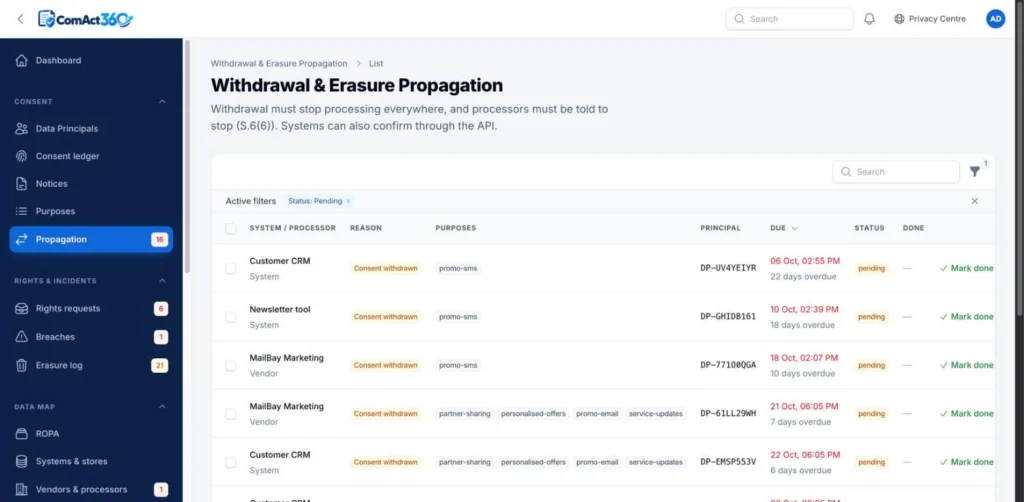
Section 6(4) says people can withdraw at any time, and doing so must be comparable in ease to giving consent. If consent was one tap, withdrawal should be one tap, not an e-mail to a support address. After a withdrawal, you must stop processing for that purpose within a reasonable time and make your Data Processors stop too (Section 6(6)). In practice the hard part is the second step: the CRM, the SMS tool, the newsletter platform and the agency list all have to stop.
Consent Managers from 13 November 2026
The Act also allows registered Consent Managers: platforms that let people give, manage, review and withdraw consent across businesses. Their rules (Rule 4 and the First Schedule) apply from 13 November 2026. A Consent Manager must be a company incorporated in India, register with the Data Protection Board and meet conditions such as minimum net worth, an interoperable platform and record-keeping. Businesses do not have to use one, but you should be ready to accept consent and withdrawals that arrive through one.
How to prove consent
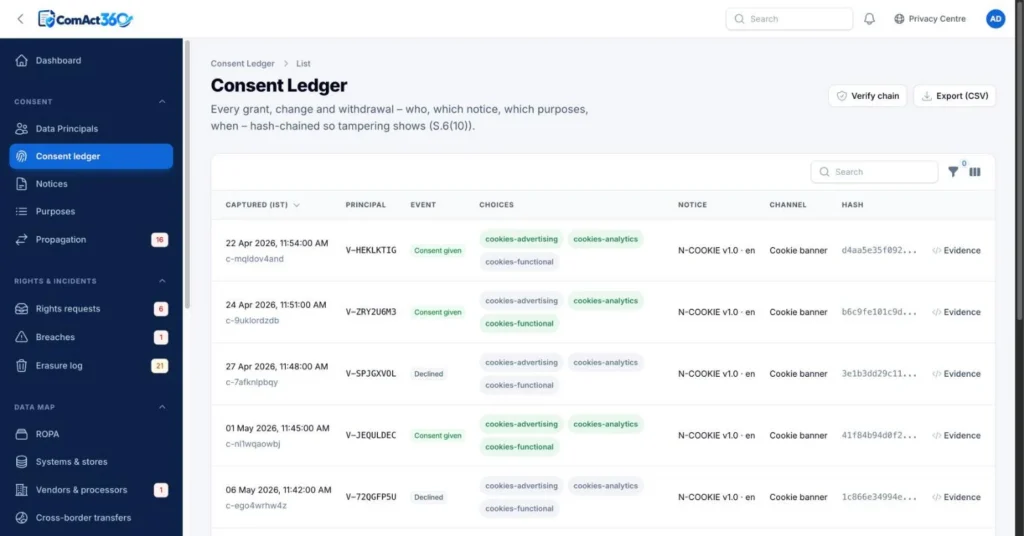
For every consent event, keep a record of:
- Who: the person, or a stable identifier for them.
- Which notice and which version they saw, and in which language.
- Which purposes they accepted or declined, one by one.
- When, and through which channel: website form, app, cookie banner, store tablet or call centre.
- Every later change and withdrawal, in order.
Store these records so they cannot be quietly edited. A hash chain, where each record includes a fingerprint of the previous one, makes any tampering visible.
Consent checklist
- Notice in plain language, itemised, with withdrawal, rights and complaint links.
- English plus the Indian languages your customers use.
- Unticked, separate choices for each optional purpose.
- Legitimate-use purposes recorded, not dressed up as consent.
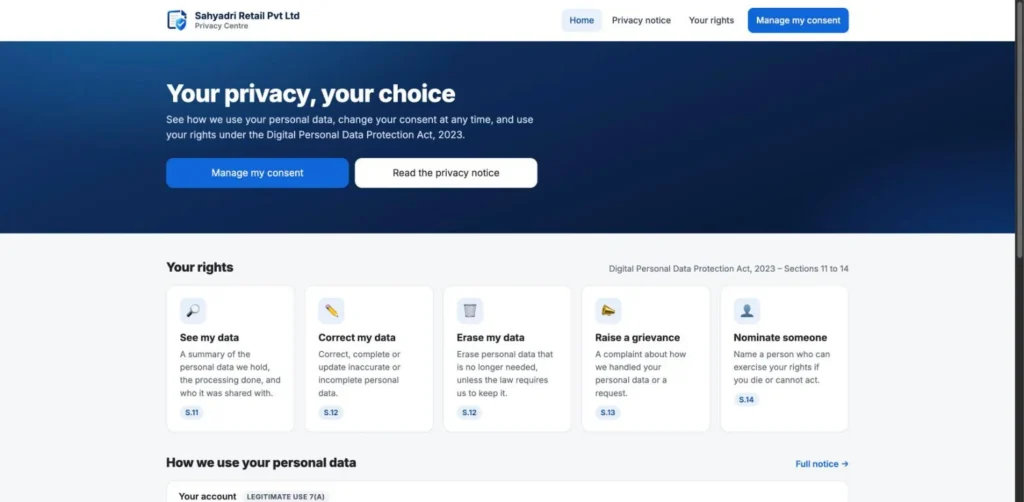
- One-tap withdrawal in the account, app, e-mail footer and Privacy Centre.
- Withdrawals passed to every system and processor, with confirmation.
- A tamper-evident consent log you can export for any person or date.
- Special handling for children: verifiable parental consent (Section 9).
How ComAct360 helps
ComAct360 by Re-Infotech keeps versioned notices, purpose-by-purpose consent and a hash-chained consent ledger in one place. A Privacy Centre lets customers change their choices and withdraw in one tap, and every withdrawal creates a task for each system and processor that must stop, tracked until it is done. The screenshots in this article are from ComAct360 with sample data.
Book a free ComAct360 demo or read our DPDP Act compliance guide for the full picture.
This guide explains the law in plain language for business owners and teams. It is not legal advice; check specific situations with your legal adviser or Data Protection Officer.
Sources and further reading
Official sources we referred to. Laws and platform rules change, so check the latest version.
- Digital Personal Data Protection Act, 2023 (India Code, Government of India)
Frequently asked questions
What is valid consent under the DPDP Act?
Consent that is free, specific, informed, unconditional and unambiguous, given by a clear affirmative action such as ticking an unticked box, and limited to the personal data needed for the stated purpose (Section 6).
Are pre-ticked boxes allowed under the DPDP Act?
No. Consent needs a clear affirmative action by the person, so a pre-ticked box or simply continuing to use a website does not count as consent.
How easy must it be to withdraw consent?
As easy as it was to give. If consent was one tap, withdrawal should be one tap, and you must then stop processing for that purpose and make your processors stop too.
When do the Consent Manager rules apply?
The rules for Consent Managers apply from 13 November 2026. Most other DPDP duties for businesses, including notice and consent, apply from 13 May 2027.
Who has to prove that consent was given?
The business. If consent is the basis for processing, Section 6(10) requires the Data Fiduciary to prove that a notice was given and that consent was given.
More DPDP guides
- DPDP Act compliance guide (start here)
- Data breach notification: CERT-In in 6 hours, the Board in 72 hours
- Handling DPDP rights requests
- Data mapping and ROPA for DPDP
- Data processor contracts under DPDP
- Cookie consent banners under the DPDP Act