
Short answer: If personal data is breached, Rule 7 of the DPDP Rules, 2025 requires you to tell each affected person and the Data Protection Board of India without delay, and to send the Board a detailed report within 72 hours of becoming aware of the breach (or longer if the Board allows it on a written request). Separately, CERT-In’s 2022 Directions require cyber incidents to be reported to CERT-In within 6 hours of noticing them. The clocks run in parallel.
Most businesses only discover how many deadlines they face in the middle of an incident. This guide sets out what counts as a breach, who you must tell, by when, what to say, and how to get ready before it happens. The DPDP breach rules apply from 13 May 2027; CERT-In reporting applies today.
What counts as a personal data breach?
The DPDP Act defines a personal data breach as any unauthorised processing of personal data, or accidental disclosure, acquisition, sharing, use, alteration or destruction of it, or loss of access to it, that compromises its confidentiality, integrity or availability. That covers far more than hacking: a customer list shared through a public link, invoices e-mailed to the wrong customer, a lost laptop, ransomware that locks patient records, or a former employee who still has access.
Who you must tell, and by when
| Who | Deadline | Under |
|---|---|---|
| CERT-In | Within 6 hours of noticing a reportable cyber incident | CERT-In Directions, 28 April 2022 (IT Act s.70B) |
| Data Protection Board: first intimation | Without delay | Rule 7(2)(a) |
| Each affected Data Principal | Without delay | Rule 7(1) |
| Data Protection Board: detailed report | Within 72 hours of becoming aware, or longer if the Board allows on a written request | Rule 7(2)(b) |
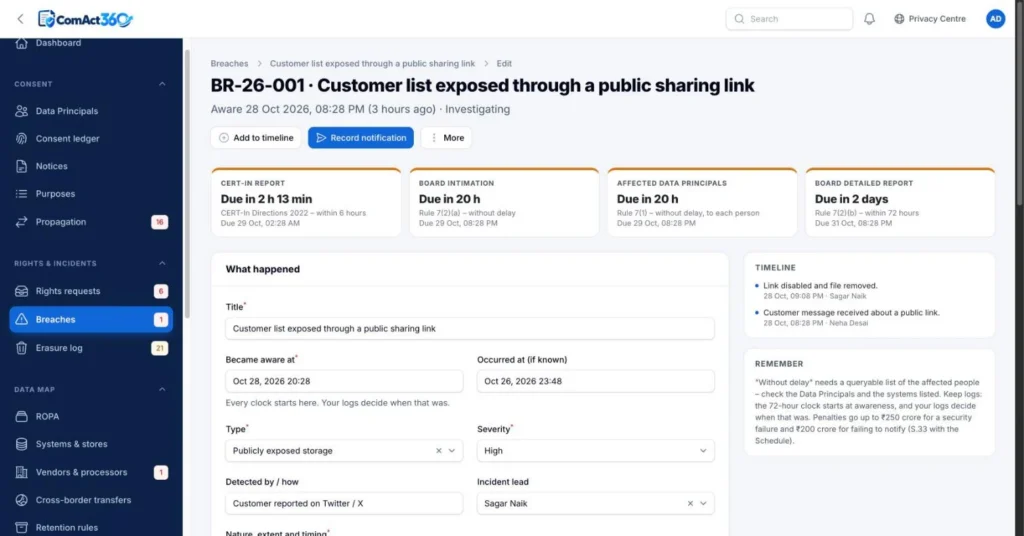
Every DPDP clock starts when your organisation becomes aware of the breach. Your logs and timeline decide when that was, so record the moment carefully.
What to tell affected people
Rule 7(1) requires a concise, clear and plain notice, sent through the person’s account or the contact details you hold, covering:
- What happened: the nature, extent, timing and location of the breach.
- The likely consequences for them.
- What you have done and are doing to reduce the risk.
- Safety steps they can take, such as changing a password or watching for fraud calls.
- Contact details of a person who can answer their questions.
What to tell the Data Protection Board
The first intimation describes the breach: its nature, extent, timing, location and likely impact. The detailed report within 72 hours adds updated facts, the circumstances and reasons for the breach, the mitigation steps taken, any findings about who caused it, the remedial measures to stop it recurring, and a report on the notices sent to affected people.
Your first 72 hours
- Hour 0: record when you became aware, open an incident record and name an incident lead.
- First hours: contain it: disable the link, revoke access, isolate systems, preserve logs. Decide whether it is a reportable cyber incident and report to CERT-In within 6 hours.
- Same day: work out which people and which data are affected from your data map and systems. Send the Board intimation and the notices to affected people without delay.
- By 72 hours: send the Board the detailed report with causes, mitigation and remedial measures.
- After: fix the root cause, update controls and train the team.
Why preparation decides the outcome
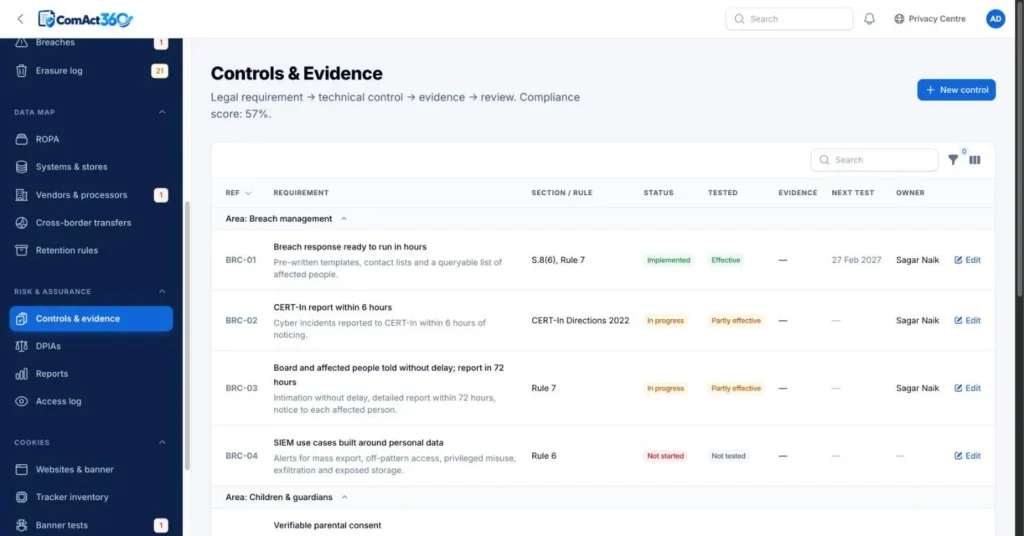
“Without delay” is only possible if you can quickly answer: whose data was in that system, how to contact them, and which vendors were involved. That depends on a current data map, a vendor register and logs. Rule 6 already requires reasonable security safeguards, including monitoring and keeping logs and personal data needed to investigate breaches for at least one year. The penalty for failing to notify the Board or affected people can reach ₹200 crore, and for failing to take reasonable security safeguards, ₹250 crore.
How ComAct360 helps
ComAct360 by Re-Infotech starts the CERT-In, Board, affected-people and 72-hour clocks the moment you log a breach, keeps a timeline of every action, and gives you draft notices with the contents Rule 7 asks for. Because systems and vendors are already mapped, the list of affected people is a query, not a hunt. The screenshots are from ComAct360 with sample data.
Book a free ComAct360 demo. For firewalls, monitoring and backups, see our IT infrastructure services.
This guide explains the law in plain language for business owners and teams. It is not legal advice; check specific situations with your legal adviser or Data Protection Officer.
Sources and further reading
Official sources we referred to. Laws and platform rules change, so check the latest version.
- Digital Personal Data Protection Act, 2023 (India Code, Government of India)
- Digital Personal Data Protection Rules, 2025 (Ministry of Electronics and IT)
- CERT-In Directions under section 70B(6) of the IT Act, 28 April 2022 (CERT-In)
Frequently asked questions
How quickly must a data breach be reported under the DPDP Rules?
The Data Protection Board and each affected person must be told without delay, and the Board must receive a detailed report within 72 hours of the business becoming aware of the breach, unless the Board allows more time on a written request (Rule 7).
Is the CERT-In 6-hour rule part of the DPDP Act?
No. The 6-hour deadline comes from CERT-In’s Directions of 28 April 2022 under the IT Act. It applies separately, so one incident can need both a CERT-In report and DPDP notices.
Does a breach include sending data to the wrong person?
Yes. Accidental disclosure or sharing of personal data is a personal data breach under the DPDP Act, even without hacking.
What is the penalty for not reporting a breach?
Up to ₹200 crore for failing to notify the Board or affected people, and up to ₹250 crore for failing to take reasonable security safeguards to prevent a breach.
More DPDP guides
- DPDP Act compliance guide (start here)
- DPDP consent management: valid consent and how to prove it
- Handling DPDP rights requests
- Data mapping and ROPA for DPDP
- Data processor contracts under DPDP
- Cookie consent banners under the DPDP Act